Knowledge

HOW TO CHOOSE A HEAT PUMP THAT WILL STILL BE THE RIGHT CHOICE IN 15 YEARS

A heat pump is an investment for 15 to 20 years, yet the purchase price is only about a fifth of its total cost. This guide explains the three criteria - seasonal efficiency (SCOP), flow temperature and hidden costs - that reveal which device will still be the right choice a decade from now.
olio1

A heat pump is one of the bigger investments in a home, and one we buy 15 to 20 years ahead. With an investment this long-term, the decision is harder than it looks. The market has grown sharply in recent years, and with it the number of models and technical figures a buyer has to make sense of. Every manufacturer highlights its own strengths and its own measuring conditions, which makes the job even harder.

The principle is simple: the lowest price on paper rarely wins over time. The purchase price is only about a fifth of the total cost of ownership. The remaining 80 percent arises only after the purchase, mostly from how efficiently the device runs in real conditions. So what should you look for?

Efficiency you feel on the bill

The key figure is the SCOP, the seasonal coefficient of performance, which tells you how much heat the device returns on average for each unit of electricity across the entire heating season. A good heat pump delivers six or more kilowatt-hours of heat from a single kilowatt-hour of electricity.

This is where the most common trap hides. Many manufacturers put the COP front and centre, but the COP measures efficiency at a single operating point, usually under favourable conditions (7 °C outside, 35 °C flow temperature). The same device may show a COP of around 5 at that point, yet only around 2.5 on a cold winter day with radiators. The COP is a snapshot of the best moment, while the SCOP is the average of the whole season and the only figure from which you can realistically estimate the annual bill. A practical rule: if an offer quotes only the COP and no SCOP anywhere, the missing value is often the answer in itself.

The differences are large in practice. An average air-to-water heat pump reaches a SCOP between 3.5 and 4.5, while top models go above 6. For the comparison to be fair, the SCOP must be measured at the same flow temperature and in the same climate zone, and ideally independently confirmed by the Keymark certificate, which verifies that the value was measured in an accredited laboratory and monitored on every production run, not just on a prototype.

Comfort and noise

When renovating older houses, the decisive factor is the flow temperature. A device that reaches up to 75 degrees Celsius usually works with the existing radiators, whereas devices with a limit of around 60 degrees often cannot provide enough heat without replacing the radiators.

Noise matters too, and not just the declared figure: the decibel scale is logarithmic, so a difference of seven decibels means not a few percent but roughly five times more sound energy. Choose a device with the lowest possible decibel value, and check the distance at which the noise was measured.

WIP MAIN House 2small

Long-term security of the investment

The device will run for two decades or more, so who stands behind it matters. European origin brings a nearby service network and readily available spare parts, whereas with devices from markets such as Asia you risk not finding authorised service when you need it most, and waiting weeks for spare parts, if they are available at all.

What the comparison showed

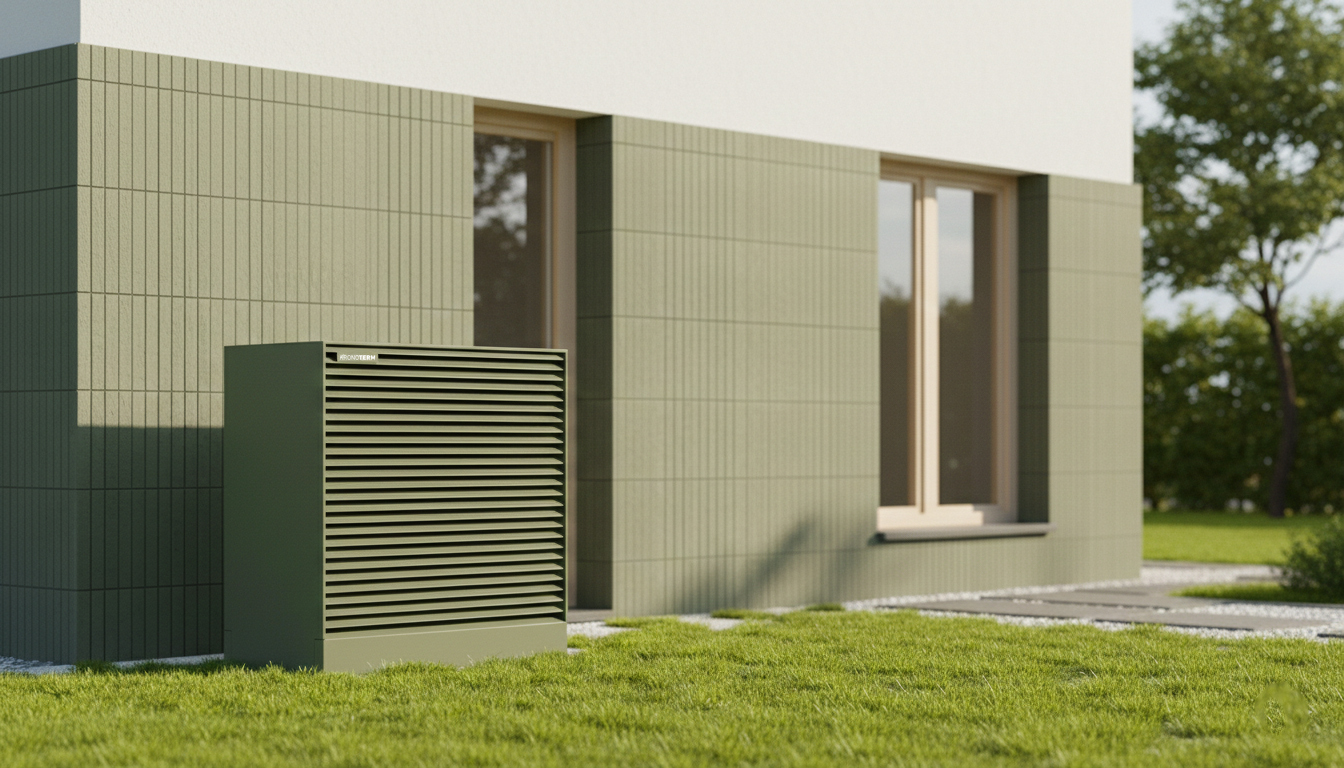
How large the differences are in practice was shown by a technical comparison that placed ten leading models in the 12 to 14 kW class under identical conditions (the EN 14825 standard, an electricity price of €0.29 per kilowatt-hour, a 15-year horizon). Among the compared devices, the annual heating cost varied by up to almost 30 percent, which over 15 years amounts to several thousand euros for the same heat and comfort. The highest seasonal efficiency among them was achieved by the European-made KRONOTERM ADAPT M.

Heating, 15 years* KRONOTERM ADAPT M Compared devices
SCOP (seasonal efficiency, 35 °C) 5.97 4.64-5.68
Noise (A7/W35) 41 dB 44-55 dB
Built-in weather and noise protection yes often not
Extra electricity use over 15 years (radiators) baseline up to €5,190
Retrofitted protection (canopy, cover) included €3,000 to €5,000
Total extra cost over 15 years up to around €9,000

*Source: technical comparison of ten leading models (June 2026, publicly available manufacturer data; EN 14825, 22,000 kWh/year, €0.29/kWh). Estimated protection costs are based on average installation costs in Central Europe.

5 questions to ask before buying

  1. Does the device carry the independent Keymark certificate?
  2. What is the SCOP, and at which temperature was it measured?
  3. What flow temperature does it reach – will it work with the existing radiators?
  4. How quietly does it run at part load, not just on paper?
  5. Where is the nearest service network, and are spare parts available?

Frequently asked questions

– 01

What should I look for when choosing a heat pump?

When choosing a heat pump, it pays to look beyond the purchase price, as it accounts for only about a fifth of the total cost of ownership over 15 to 20 years. Three criteria are decisive: seasonal efficiency (SCOP), flow temperature (whether the device works with existing radiators) and long-term security (origin, service network, hidden costs). An independently verified value, for example one confirmed by the Keymark certificate, is more reliable than a figure stated only on paper.

– 02

What is the difference between COP and SCOP in a heat pump?

+

The COP is the efficiency of a heat pump at a single operating point, usually under favourable conditions (7 °C outside, 35 °C flow temperature), while the SCOP is the average efficiency across the whole heating season under the EN 14825 standard. The same device may have a COP of around 5 but only around 2.5 on a cold winter day with radiators, so the SCOP is what matters for estimating the annual bill. If an offer quotes only the COP and no SCOP, the missing value is often the answer in itself.

– 03

What is a good SCOP for an air-to-water heat pump?

+

An average air-to-water heat pump reaches a SCOP between 3.5 and 4.5, while a value above 5 is considered excellent. Top models go above 6; the KRONOTERM ADAPT M reaches a SCOP of up to 5.97 for underfloor heating (35 °C) in an average climate, confirmed by the Keymark certificate. Two SCOP values are comparable only at the same flow temperature and in the same climate zone.

– 04

Will a heat pump work with existing radiators?

+

A heat pump works with existing radiators if it reaches a high enough flow temperature. A device that prepares water up to around 75 °C – as the KRONOTERM ADAPT M does – usually works with existing radiators, whereas devices with a limit of around 60 °C often require replacing the radiators or adding another heat source. That is why the flow temperature is a key figure when renovating older houses.

– 05

Why is the cheapest heat pump not necessarily the cheapest choice?

+

The purchase price is only about a fifth of a heat pump’s total cost of ownership; the remaining 80 percent arises only after the purchase, mainly from electricity use. A device with a higher SCOP, lower noise and built-in weather protection can save several thousand euros over 15 years compared with a less efficient one, even if it cost more at the start. That is why, in technical comparisons, the device with a slightly higher initial price often turns out to be the cheapest choice.


Tags: ,