SCOP up to 8.48
ETERA water-to-water, EN 14825

COP, SCOP and What Modern Systems Actually Deliver
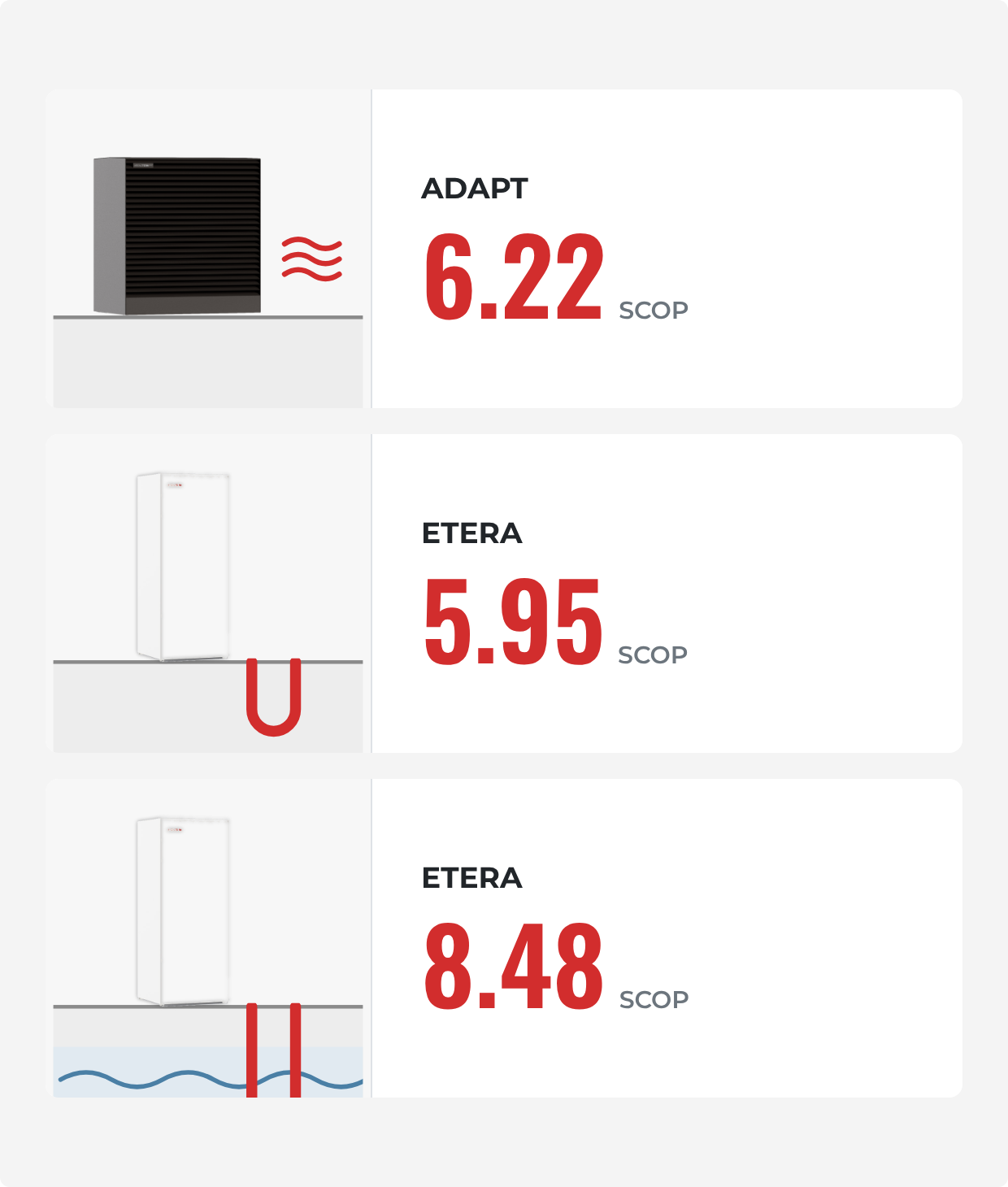
Heat pump efficiency is the ratio of heat delivered to electricity consumed. Modern systems run at 300-500% seasonal efficiency, and top models like KRONOTERM ADAPT reach 622% (SCOP 6.22), while ETERA in water-to-water mode reaches 848% (SCOP 8.48). This guide explains COP, SCOP and SPF, what drives real-world performance, and how to maximise efficiency in your home.

ETERA water-to-water, EN 14825
A heat pump’s efficiency is the ratio between the electricity it consumes and the heat it delivers. Unlike a gas or oil boiler that converts fuel into heat, a heat pump moves existing thermal energy from the air, ground or water – so it can deliver several units of heat for every unit of electricity used. Theoretical efficiency measured in laboratory conditions gives the Coefficient of Performance (COP); real-world efficiency in your home across an entire heating season gives the Seasonal Performance Factor (SPF). SPF is typically lower than COP because real installations include defrost cycles, controls and parasitic energy use – that is normal, not a fault.
A heat pump does not turn electricity into heat. It uses electricity only to drive a compressor that moves thermal energy which already exists in the outside air, the ground or groundwater into your home. The clearest picture is a refrigerator in reverse: a fridge moves heat from inside to outside, a heat pump moves heat from outside to inside.
Because that heat is already there, the electricity only has to pay for moving it, not for making it. That is the whole reason the numbers can go above 100%.
For the full cycle step by step, see our complete heat pump guide.
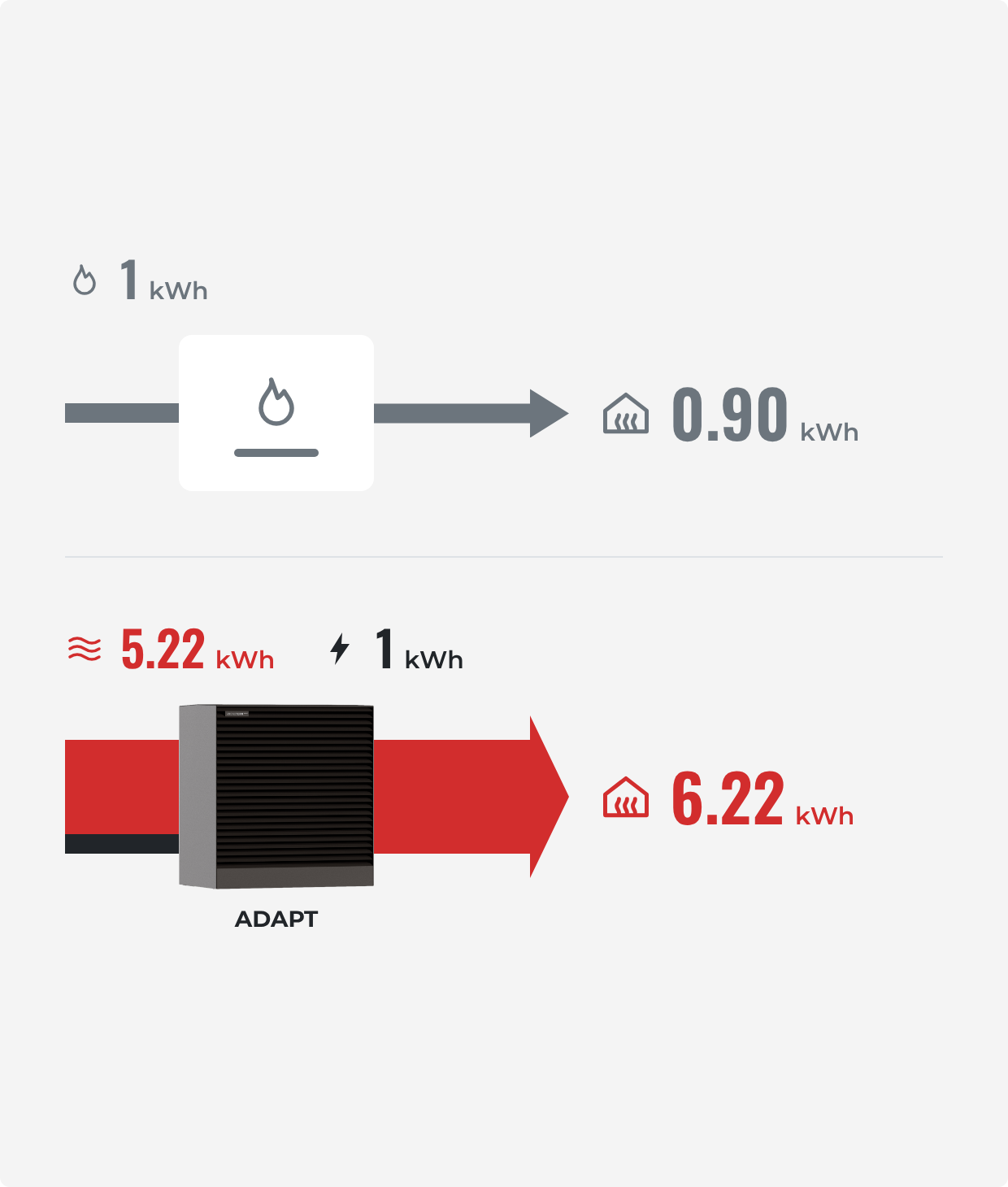
Only a fraction of the heat that reaches your radiators comes from your electricity meter. KRONOTERM ADAPT uses 1 kWh of electricity and delivers 6.22 kWh of heat, so 5.22 kWh arrived free from the outside air. With ETERA in water-to-water mode the figure reaches 8.48 kWh of heat from 1 kWh of electricity.
This is why heat pump efficiency routinely sits between 300% and 850%, while even the best gas boiler stops just below 100%. Independent data from the Energy Saving Trust confirms similar real-world averages for UK installations.
How heat pumps actually work
How does our ADAPT heat pump actually perform?
Heat pump efficiency is calculated as heat output divided by electrical input. Under fixed laboratory conditions this gives the Coefficient of Performance (COP) – a ratio of 5.0 means 5 kWh of heat per 1 kWh of electricity. Real-world factors lower the ideal value: defrost cycles, controls, parasitic energy and seasonal temperature swings all reduce the measured figure compared to lab tests. The Seasonal Coefficient of Performance (SCOP) accounts for this by averaging across a full heating season under EN 14825.

COP (Coefficient of Performance) is measured in the laboratory under EN 14511, at one fixed operating point, usually 7 °C outdoor air and 35 °C flow temperature. It tells you how good the machine is under ideal conditions. Useful for comparing the underlying technology of two heat pumps, but it does not tell you what the unit will do across a real winter.
SCOP (Seasonal Coefficient of Performance) is the figure on the EU energy label and the one worth comparing. Defined by EN 14825, it averages performance across four part loads and three reference climates: warmer (Athens), average (Strasbourg) and colder (Helsinki). KRONOTERM ADAPT reaches SCOP 6.22 and ETERA reaches 8.48, both independently verified through EHPA HP Keymark certification.
SPF (Seasonal Performance Factor) is measured on the finished installation through a real heating season, and it counts everything: defrost cycles, controls, circulation pumps. SPF usually lands 0.3 to 0.6 below the certified SCOP. That is normal and not a fault. Even at SPF 4.0, a heat pump uses 4.4 times less primary energy per unit of heat than a 90% efficient gas boiler.
Compare SCOP, and compare it for the climate zone closest to yours. COP alone will flatter a unit that struggles in winter, and SPF cannot be known before the system is installed. Ask the installer for the SCOP at the flow temperature your house will actually run at, because a value quoted at 35 °C does not apply to a house heated by old radiators at 55 °C.
Four things decide what your heat pump actually delivers: flow temperature, building insulation, system sizing and source temperature. Flow temperature is the largest lever you control by design. Every 1 °C you take off the average flow temperature adds 2 to 3% to seasonal efficiency, which is why underfloor heating and larger radiators pay back faster than almost any other upgrade.

The temperature of the water your heating system needs. Running at 35 °C instead of 55 °C can lift seasonal efficiency by 25 to 35%. Underfloor heating and upsized radiators are what make those low temperatures possible, because they hand over the same amount of heat from cooler water across a larger surface.
Insulation decides how much heat your house loses, and therefore how hard the heat pump has to work. An older house with little or no wall insulation uses 30 to 40% more electricity per year than a modern house with 15 to 20 cm of insulation, for the same indoor temperature.
Size is not about picking the most powerful unit. A heat pump reaches its highest efficiency when it runs long, steady cycles at part load. A unit that is too powerful for the house switches on and off repeatedly instead, and every one of those starts costs efficiency. This is decided during sizing, before anything is installed, and it cannot be corrected by settings afterwards.
Where the heat comes from has the largest single influence on year-round SCOP. Outdoor air swings between -10 and +25 °C. Ground at 1.5 to 2 m depth varies between 7 and 15 °C through the year. Groundwater holds a stable 7 to 12 °C. The warmer and steadier the source, the less work the compressor does, which is why water-to-water systems regularly reach SCOP 8 and above.
Water-to-water heat pumps are the most efficient because their source temperature stays at a stable 7-12 °C all year – KRONOTERM ETERA reaches SCOP 8.48. Ground-source systems follow, with stable performance year-round. Air-to-water units are easiest to install and the most common across Europe; the best models like KRONOTERM ADAPT reach SCOP 6.22 even with outdoor air as the variable source. See the Heat Pump Association UK for industry-wide UK performance data.

| Heating system | Water-to-water heat pump | Ground-source heat pump | Air-to-water heat pump | Modern gas boiler | Oil boiler |
|---|---|---|---|---|---|
| Seasonal efficiency (SCOP) | KRONOTERM ETERA reaches 8.48 | KRONOTERM ETERA reaches 5.95 | KRONOTERM ADAPT 2 reaches 6.22 | 0.85 – 0.90 (90% max) | 0.80 – 0.85 (85% max) |
| Why this SCOP | Direct heat exchange with 7-12 °C groundwater – no brine loop, no source cooling during heating season. | Closed brine loop in vertical borehole; 8-12 °C source slightly cools during heating season – some thermal resistance. | Variable -10 to +25 °C outdoor air; R290 refrigerant and Alpine engineering maintain SCOP down to -25 °C. | Combustion physics cap efficiency at ~90% – rest lost up the flue. | Higher flue and combustion losses than gas; older underlying technology. |
ETERA: a low-energy house with the most efficient heating system
ETERA: what do we need for a geothermal heat pump?
Four decisions separate a heat pump that reaches its certified efficiency from one that falls 15 to 25% short. None of them is expensive on its own, and all of them are made either before installation or during commissioning. Here is what to ask for.

Before anyone quotes you a model, ask for a room by room heat loss calculation for your house. That number is what the sizing should be based on, not the floor area and not the rating of the old boiler. Ask to see it in writing.
Ask what flow temperature the system is designed for. If the answer is 50 °C or more, ask what it would take to reach 40 °C. Usually it means underfloor heating in the rooms being renovated, or a few larger radiators in the rooms that lose the most heat. Of everything on this page, this is the change with the largest return.
Weather compensation lets the heat pump raise the flow temperature only as much as the weather demands. A properly set curve lifts seasonal efficiency by 20 to 30% compared with a fixed setting. Avoid deep overnight setbacks, because steady operation beats large swings. With CLOUD.KRONOTERM you can watch the real figures and refine the curve over the first season.
Refrigerant charge and water flow drift over time, and a 30 minute annual check keeps performance where it started. If you are insulating the building anyway, do that first, because lower heat loss makes every other gain larger.
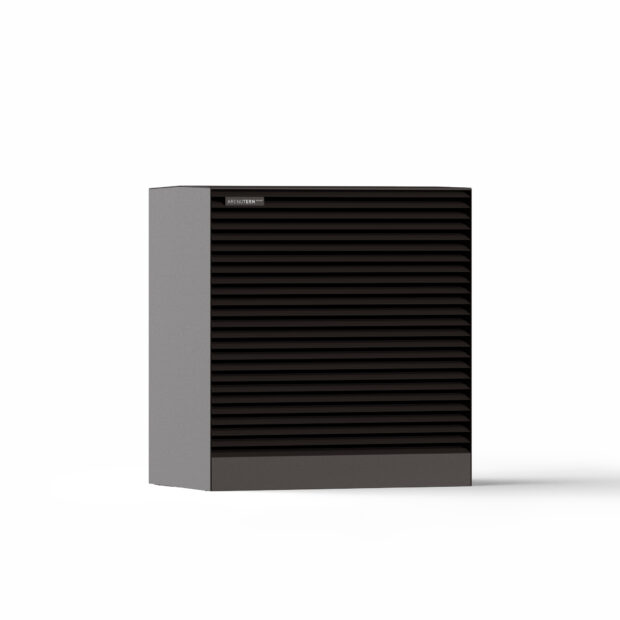
Premium air-to-water heat pump with SCOP up to 6.22
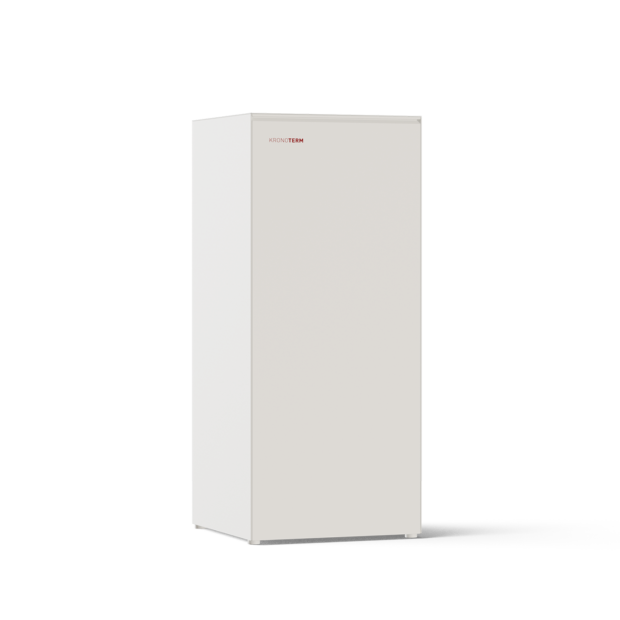
Water-to-water or air-to-water – the highest SCOP in the range (8.48)
A heat pump’s efficiency is the ratio of heat it delivers to the electricity it consumes – modern systems run at 300-500% efficiency, and top KRONOTERM models like ADAPT (SCOP 6.22) or ETERA (SCOP 8.48) deliver up to eight times more heat than the electricity they use. Efficiency is measured as COP at a single operating point or as SCOP across an entire heating season.
Because a heat pump does not generate heat from electricity – it moves heat that already exists in the air, ground or water into the home. Electricity powers only the compressor and circulation pumps, so the system delivers three to eight times more heat than the electricity it consumes.
The difference is timing: COP measures efficiency at a single operating point in the lab, usually at 7 °C outdoor air and 35 °C flow temperature. SCOP averages efficiency across the full heating season under EN 14825, factoring in real temperature variation, four part-load conditions and parasitic energy use. SCOP is the more useful figure for predicting real running costs.
SPF (Seasonal Performance Factor) is the efficiency measured on the installed system through a real heating season. It includes auxiliary energy use like defrost cycles and circulation pumps. SPF is typically 0.3 to 0.6 lower than the SCOP rating – that is normal – and it is the figure most national grant schemes care about.
A realistic SCOP for an air-source heat pump in UK/Irish climate is between 3.5 and 4.5, with excellent systems reaching 5.0 and above. Top-tier units like KRONOTERM ADAPT hit SCOP 6.22 under EN 14825 average climate – nearly 50% above category average. The exact figure depends on flow temperature design, insulation and installation quality.
Efficiency does fall as the outdoor temperature drops, but less than most people expect, and it stays above a boiler at every point. A high-efficiency air-to-water unit delivers around COP 5.0 at +8 °C, around 3.0 at 0 °C and around 2.0 at -5 °C. Even at -5 °C it is still producing twice as much heat as the electricity it uses. KRONOTERM units keep heating down to -25 °C, so there is no outdoor temperature in the UK or Ireland at which the system stops working.
Water-to-water systems are most efficient in winter because groundwater stays at a stable 7-12 °C year-round – KRONOTERM ETERA reaches SCOP 8.48 in this mode. Ground-source follows, then air-to-water. Top air-to-water models like KRONOTERM ADAPT still reach SCOP 6.22 and operate down to -25 °C, so full heating performance even in continental winters.
Lower the design flow temperature – switching to underfloor heating or upsized radiators is the biggest single lever. Improve insulation, set up weather compensation properly, avoid aggressive overnight setbacks, and schedule annual servicing. Every 1 °C drop in flow temperature raises overall efficiency by 2-3%.
Yes – significantly. A condensing gas boiler caps out at around 90% efficiency, with the rest lost up the flue. A modern air-to-water heat pump runs at 300-500% seasonal efficiency, and KRONOTERM models reach above 800% (ETERA water-to-water, SCOP 8.48). That is the efficiency gap: a heat pump delivers 4 to 8 times more heat per unit of primary energy than the best gas boiler.
The efficiency gap is even larger than against gas. Oil boilers typically achieve 80-85% efficiency, while modern heat pumps deliver 350-850% seasonal efficiency. For the same heat output, a heat pump uses 4 to 10 times less primary energy than oil heating. Switching from oil to a high-efficiency heat pump like KRONOTERM ADAPT (SCOP 6.22) typically cuts heating costs by 60-75%.
Usually yes, but the size of the saving depends on what you pay for electricity against what you pay for your current fuel, not on efficiency alone. The quick check: divide your electricity price per kWh by the SCOP, then compare the result with your gas or oil price per kWh divided by 0.9. Homes switching from oil typically land 60 to 75% lower. Your insulation, your flow temperature and your tariff all move that number, so ask your installer to run it with your own figures before you decide.
When comparing heat pumps, check the SCOP under EN 14825 for your climate zone (UK and Ireland fall closest to “Average”), the operating temperature range (KRONOTERM ADAPT works down to -25 °C), the sound pressure level (16 dB at 5 m is exceptional), and the refrigerant type – natural R290 is future-proof against EU F-gas rules. A SCOP above 5.0 indicates premium efficiency.
No – underfloor heating helps but isn’t required. The key is the design flow temperature, not the emitter type. Underfloor heating allows the heat pump to run at low flow temperatures (35-40 °C) where efficiency peaks. Upsized radiators do the same job in retrofits. Every 1 °C lower flow temperature raises seasonal efficiency by 2-3%.
Yes. All KRONOTERM heat pumps carry the EHPA HP Keymark – the European quality label awarded by the European Heat Pump Association based on independent third-party testing under EN 14511 and EN 14825. ADAPT and ETERA are tested under TUV protocols, ensuring published SCOP figures (ADAPT 6.22, ETERA 5.95 ground-source and 8.48 water-to-water) match field performance.